Friday, October 26, 2012

Transportation Trends + Bikes

On my way home the other night, I was thinking about the transportation mode shift that's been happening across the country for several years and how that's affecting young people:  people are driving few miles every year.  There was a study done by the US Pirg's and others that shows some pretty interesting trends. Translate that study into policy and infrastructure needs, and the take away result is we don't need more miles of new roadway. Let's take a closer look.

1. Decrease in vehicle miles traveled by the average US citizen.  Why is this important?  From World War II up until just after 2000, the rate of vehicle miles traveled was on a pretty steady upward trend. In 2004, that rate dropped - and that was before the economy tanked in 2008. In 2011, the average US citizen drove 6% fewer miles than in 2004. That's an increasingly downward trend.

2.  Decrease in vehicle miles traveled by young adults.  What does this mean? Young adults are the age group of 16 - 34 year olds. This means the youngest generation that can drive is driving less - and the study shows that they are riding public transportation, bicycles and walking more.

3.  Fewer young adults are getting their license.  Why does this matter? Those who are 14 - 34 years old are choosing to forfeit the right to drive. From 2000 - 2010, the rate of those who did not have their license went up from 21% to 26%. The study cites all kind of reasons for this change - technology making alternative transportation choices and modes more convenient, increase in fuel prices and changes in driver licensing laws. Graduated licenses, more restrictions behind the wheel and the cost of private classes and tests are all barriers that have contributed to this trend.

These, along with other factors cited in the report paint an interesting picture of our national transportation trends. Especially for young adults - teens, college students and young professionals are all more likely to chose an alternative way to move around than their parents. Cars are less appealing to younger people. I'm sure that getting carted around at a young age in an SUV from school to soccer practice to play dates to piano lessons for many in this generation influenced this trend. Not to mention the increasing cost of living - and the rise in higher education cost and debt. It seems like people today are looking at unconventional ways to stretch a dollar or save a penny. Not buying a car (or having to pay for gas or car insurance) is a huge investment towards the "dollar saved is a dollar earned" mentality.

Using a bicycle to get around is fast, inexpensive and healthy - and addresses some of the concerns listed above. With increased public awareness and concern about the obesity epidemic, climate change and college debt, young adults today are responding to the outcry by changing their behavior in a pretty radical way. They are taking to their bikes in a way that future generations have not. It's a pretty cool and noteworthy trend.

Monday, October 22, 2012

Bicycle Friendly Across Borders

That was the theme of the two state Bike Summit in Augusta, GA this past weekend. And reach across borders it did. Folks from Georgia, South Carolina, North Carolina and other places gathered to discuss, listen and share in the excitement of the rise of biking in the Southeast.

Georgia-lina Bike Summit
The idea for Georgia Bikes! third summit naturally took form when the conference landed in a border city. And it really makes sense - when riding, rarely are border or boundaries recognized. Sometimes there's a change in the pavement, but otherwise most people on bikes don't know when they are entering or leaving one city to the next.

Topics covered included how the advocacy community can respond to tragedy when it strikes, mountain biking club meetings, learning more about bike share for the southeast, effective advocacy ideas, bike data collections, learning how to put on a bicycle ride or tour, how to be a Bicycle Friendly Community, a women's cycling forum, bikeway planning at universities and the Safe Routes to School program. Guest speakers from the East Coast Greenway and the Alliance for Biking and Walking also gave inspiring speeches.

There was a nice demographic representation, too. It was nice to hear stories from the young and the young at heart, city folks, country folks, mountain bikers, cyclists, guys, girls, planners, advocates, students, professionals - anyone and everyone that loves bikes!

Thursday, October 11, 2012

(A sample of) Bikeways in Greenville

A while back, I had the opportunity to visit some of the bikeways in Greenville. Greenville has bike lanes, shared roadways and paths that are built for cyclists to use.

Heritage Historic District. Greenville, SC.
The narrowed road and "sharrow" treatment provide an entry point feeling into this residential area just a few minutes from downtown. The streets speed limit is slow and there's light residential traffic, so having a shared roadway makes sense here. What a great addition to the Heritage Historic District neighborhood.

Bike lane to shared roadway. Greenville, SC
Near Main Street off of downtown, on North Spring Street there's a creative example of retrofitting the existing road to accommodate bikes. The road was wide enough to accommodate a bike lane - until near the intersection. Watch this short video to see how traffic reacts.


The idea is that neither a biker nor a car has the right of way. As the sign state, "Share the Road." This kind of development is intended to build awareness, slow down traffic and let folks know that bikes are allowed to be here. I like the take on the share the road sign that's found near the intersection. It would be interesting to watch how a car and bike interact when approaching this intersection.

What a view! Greenville, SC
Looking north on North Main Street, bike lanes have transformed the street! Bike lanes can be seen on either side of the road. Street parking was retained, a middle turn lanes allows for traffic flow and folks who want to get around by bike have a way to do so. This road is particularly compelling because it comes into view over the crest of a hill.

Greenville's has done a good job of implementing the network of bikeways proposed in their master plan for cyclists of all types to use. Keep up the good work leading the Upstate.

Monday, October 8, 2012

It's what Women Want

This is a (video) story. About a woman. And her life. How she went from having a suburban to pedaling her (six) kids. It's simple. It's funny. It's interesting. And it's inspiring. Here's Emily Finich:  In her own words.


Wednesday, September 26, 2012

10 Steps to Creating a Bike Lane

Ever wonder what goes into transforming a roadway into a bikeway? What a road looks like before and after a bike lane is installed? There are many steps that go into that process. Here's an overview.

Step 1
Step 1:  Start with a road. This one has a lane in each direction and parallel parking.

Step 2:  Measure, plan and discuss what can be done within the existing budget, right of way and curbs to accommodate bikes. Consider the role and place for pedestrians, bikes, cars, buses and emergency vehicles along the corridor. (It's about choices, people!)

Step 3:  Make a decision to install a bike lane.
(Step 3A:  Celebrate the decision to install a bike lane with maybe a press release, by telling local advocates)

Step 4
Step 4:  Get some experienced professionals to remove existing striping OR resurface the road. Chose paint or thermoplastic to mark the bike lane. In this instance, paint was chosen. So, on we go!

Step 5:   After the bike lane is marked, determine the locations of the bike lane pavement markings (aka guy on a bike) within the bike lane using recommendations from design guidelines, DOT recommendations, AASHTO and NACTO references. Mark these locations out in the field.  

Step 6
Step 6:  After predetermining the locations, lay down the stencils.

Step 7
Step 7:  Get your paint and reflective beads ready.

Step 8a
Step 8b
Step 8:  Paint the bike guy and then the arrow.

Step 9
Step 9 continued


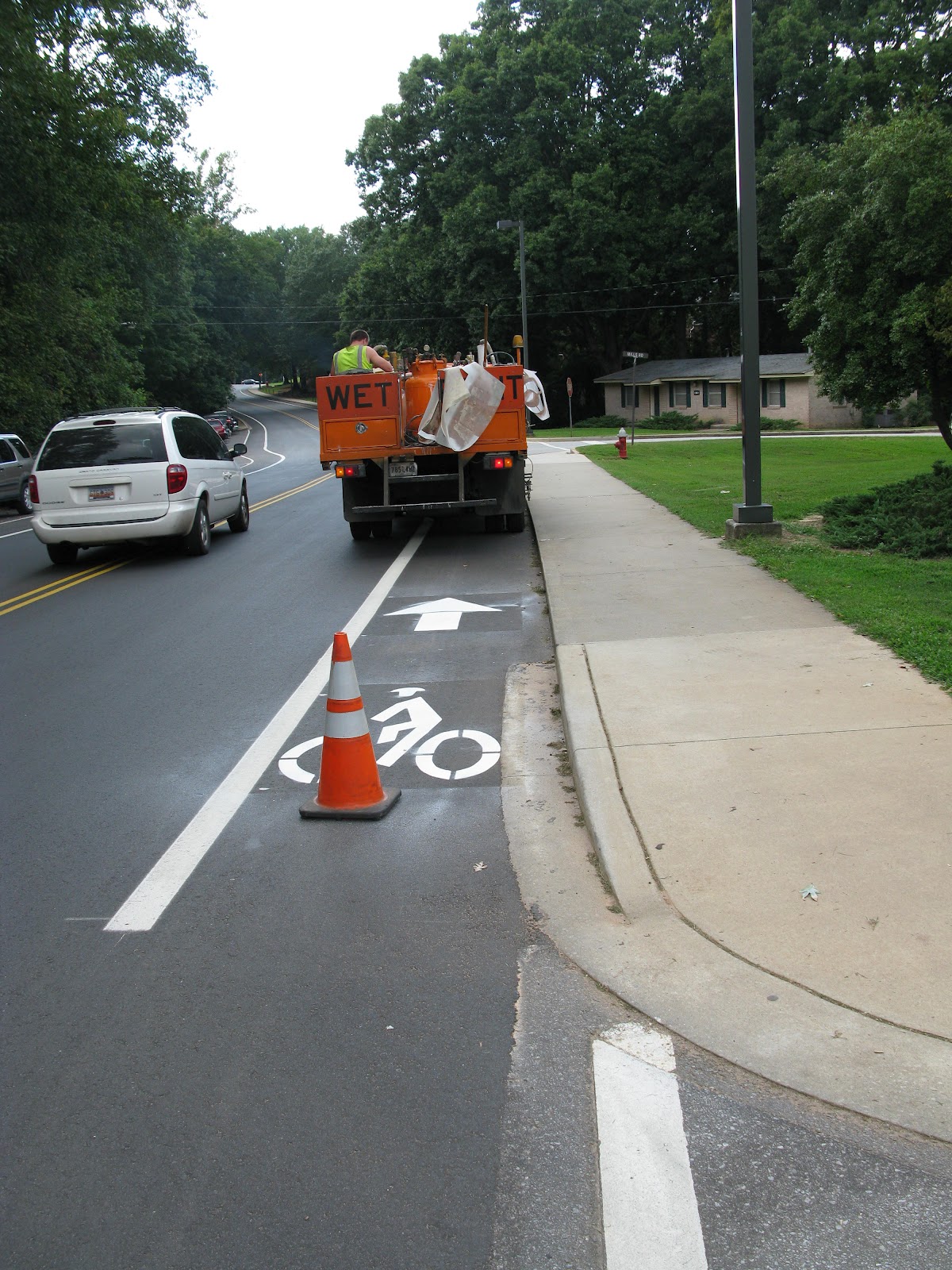
Step 9:  Remove stencils carefully. (The paint will still be wet and there's no giant eraser that works on asphalt!)


Step 10:  Mark with cone. Let dry.


Complete!
And....Voila! A completed bike lane. 

Okay, so obviously there's a lot more to it then that. The planning and approval process can take months. (If you noticed, there were quite a few parking spaces that were sacrificed in the name of this bike lane. However, that isn't always the case.)  It takes time, patience, collaboration and compromise. But it's not rocket science. And the affects are transformational.

Tuesday, September 18, 2012

GA/SC Bike Summit

Every so often, it's a good idea to get together to discuss what's going on in the world as it relates to biking. Advocates, engineers, public health officials, planners, media, professional riders, community members, politicians - everyone. It's important to talk about, listen to and share experiences to build a better place to bike.

Last week, the national  Pro Walk/Pro Bike Conference was held in Long Beach, CA. There are a ton of interesting topics, programs and ideas that are coming out of the conference. A few of them include: 
All of these are interesting ideas to consider and have a place within the biking world of the Upstate. It will be interesting to see how these things are implemented here.

In the Upstate, we have an opportunity to have our own discussion. The Georgia-lina Bike Summit will be taking place in Augusta, Georgia from October 19-21. Sponsored by the Georgia Bikes! and Palmetto Cycling Coalition state advocacy groups, the two-state summit aims to draw folks together from the southeast to talk about the biking issues here. Recognizing the unique state of our states' biking culture and infrastructure will allow us to address our needs. Consider attending the Georgia-lina Bike Summit to participate in the discussion on recreation, transportation, opportunities, challenges, issues, progress related to biking in the Upstate.

Sunday, September 9, 2012

Bicycle Safety 101: Using Turn Signals on a Bike

Did your bike come with turning signals? No? They rarely do. However, there are a few simple things to help others figure out where you might be headed when riding your bike.

Some may remember being taught different ways to bend your arm to indicate a change in direction or stopping to traffic. I think that was envogue in the late 1980's and early 1990's. That's changed for today's cyclists. Just remember these 3 simple tips:

1Point to turn. To make a left turn, point to the left with a finger or hand. To make a right turn, point to the right with a finger or hand.

2.  Count to 5. Stick your hand or finger out in the intended direction of travel, and count out 5 seconds. This gives others around you time to see that you're going to do something.

3. Turn left or right. Preferably not into on-coming traffic or into pedestrians.

It's that simple!  Balancing on your bike with one hand while signalling may take a little bit of practice. These small steps will go a long way in communicating to others that a change is about to happen. It's like using a turn signal in a car.

There arm signal for stopping isn't used anymore (like it was a few decades ago). To help others around you react to the change in speed, consider slowly coming to gradual stop. It's better for them and for your bike's brakes.

When you're on your next ride, whether it's on the road or on a path, remember these three simple tips:  point, count and turn.